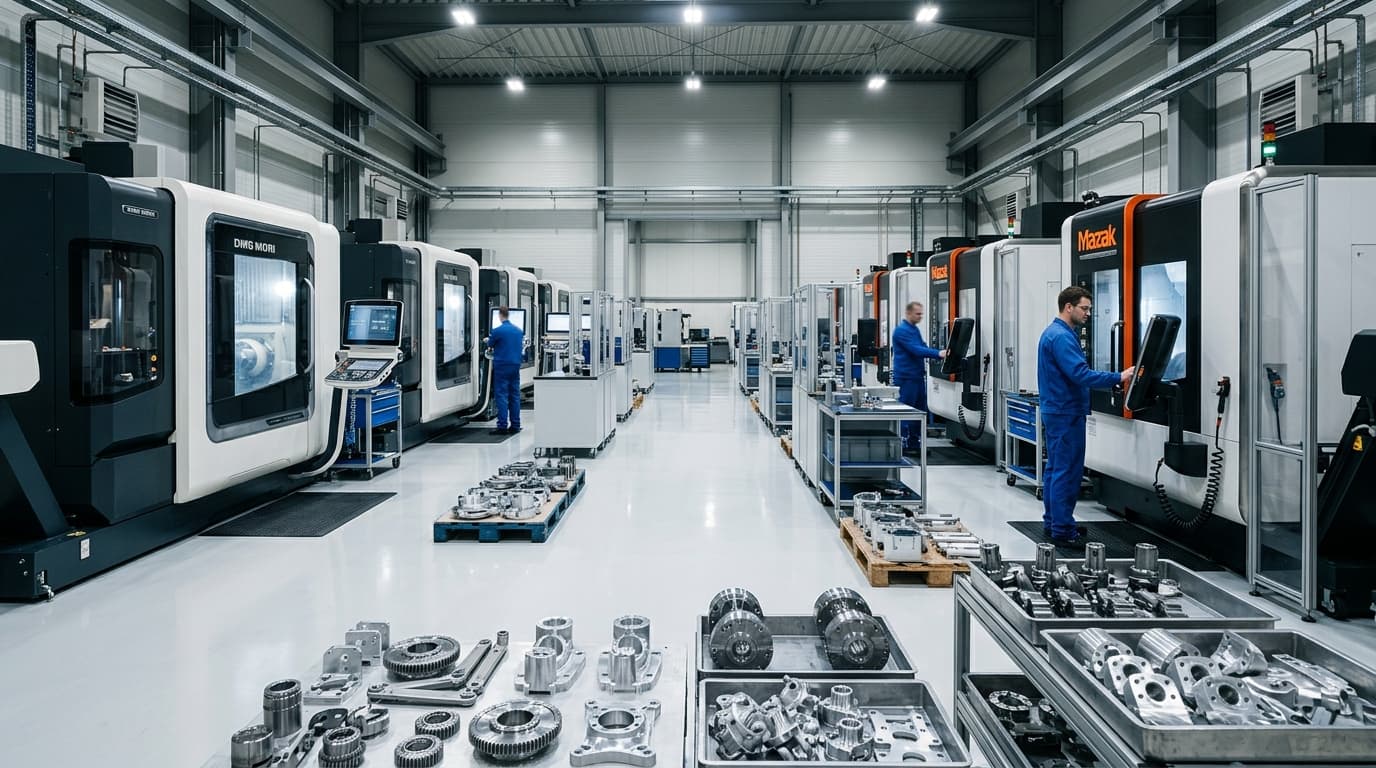
The Hidden Costs in Custom Robot Servo OEM Manufacturing
A transparent breakdown of tooling, NRE, PCBA, and supply chain costs when scaling custom robotic joints from prototype to mass production.
Executive Summary (TL;DR)
- Optimizing solely for BOM cost masks severe Non-Recurring Engineering (NRE) risks; buyers must evaluate the total cost of prototype validation and tooling.
- Custom servo PCBA tooling, firmware integration, and environmental testing often represent the bulk of hidden costs before mass production.
- A transparent 12-gate execution framework prevents supplier lock-in and defines clear FAT (Factory Acceptance Test) ownership.
Moving Beyond the "Per Unit" Price Tag
When hardware teams evaluate custom robot servos, the most common first question is: "What is the unit price for 1,000 pieces?"
While the mass production unit price matters, optimizing solely for the cheapest BOM often masks severe financial risks downstream. The journey from a napkin sketch to 1,000 reliable, field-tested robotic actuators contains several layers of Non-Recurring Engineering (NRE) and tooling costs. Understanding these hidden costs allows procurement teams to budget accurately and avoid supplier lock-in traps.
If you are navigating the quoting process, be sure to read our Custom Robot Servo RFQ Guide to understand the specifications you must provide to suppliers.
Detailed Cost Categories
A true OEM partnership relies on financial transparency. When analyzing a supplier's quote, ensure they break down costs into the following explicit categories rather than baking them indiscriminately into unit prices.
| Cost Category | Key Line Items | Realistic USD Range | What to Check |
|---|---|---|---|
| Tooling | Lamination progressive dies, Housing injection/die-casting molds, PCBA stencils, SMT pallets | $8,000 - $35,000 | Is tooling owned by you? What is the guaranteed shot life of the molds? |
| NRE (Non-Recurring Engineering) | Motor electromagnetic design, Custom PCB layout (HDI), Firmware customization, Thermal simulations | $10,000 - $45,000 | Does this include multiple design spins? Who owns the source code and Altium files? |
| Validation & Compliance | Dyno load testing, Thermal cycling (-40°C to +85°C), Vibration (MIL-STD), EMC testing (FCC/CE), Accelerated Life Testing (ALT) | $15,000 - $60,000 | Are 3rd-party lab reports provided? Learn more about the physics involved in our Thermal Derating Physics Guide. |
| Production Fixturing | Custom assembly jigs, EOL (End-of-Line) calibration stations, automated torque test rigs | $5,000 - $25,000 | Will the EOL data be exported to your cloud infrastructure? |
The 12-Gate Execution Framework
To structure the complex process of custom robot servo engineering, we recommend adhering to a strict gate-driven methodology. This prevents "scope creep" and ensures validation occurs before massive capital is deployed on hard tooling. See our deep dive on the 12-Gate Prototype to Mass Production Execution.
| Gate | Deliverable | Typical Duration | Cost Range (USD) | Owner |
|---|---|---|---|---|
| G1: PRD Sign-off | Final Product Requirements Document, Envelope CAD | 2-4 Weeks | $0 (Pre-sales) | Joint |
| G2: Architecture | Thermal sim, Electromagnetic FEA, PCBA block diagram | 2-3 Weeks | $3k - $8k | OEM |
| G3: EVT Build | Engineering Verification Test (soft tooling, 5-15 units) | 6-8 Weeks | $10k - $25k | OEM |
| G4: EVT Review | Lab testing, basic dyno validation, major bugs identified | 2-3 Weeks | $5k - $10k | Joint |
| G5: DVT Design | DFM updates, hard tooling kick-off | 3-4 Weeks | $15k - $40k (Tooling) | OEM |
| G6: DVT Build | Design Verification Test (hard tooling, 30-50 units) | 8-12 Weeks | $15k - $30k | OEM |
| G7: DVT Validation | Environmental, life testing, EMC compliance | 4-6 Weeks | $10k - $30k | OEM / 3rd Party |
| G8: PVT Build | Production Verification Test (assembly line run, 100+ units) | 4-6 Weeks | Unit BOM Cost | OEM |
| G9: PVT Review | Yield rate analysis, EOL test station validation | 2-3 Weeks | $5k - $10k | Joint |
| G10: MP Release | Mass Production documentation lockdown | 1-2 Weeks | $0 | Joint |
| G11: FAT / Outbound | Factory Acceptance Testing per batch | Ongoing | Baked in BOM | OEM |
| G12: Sustaining | Cost-downs, yield improvements, RMA analysis | Ongoing | N/A | OEM |
Amortization: Volume vs. Unit Price
A major factor in the business case for a custom servo is how NRE and tooling costs are amortized over production volumes.
Supplier Lock-in Red Flags
Opaque suppliers often use a "Razor and Blades" model: they subsidize upfront development costs to lock you into a proprietary architecture, ultimately holding your supply chain hostage when you attempt to scale.
| Red Flag | Why It's Dangerous | What to Negotiate |
|---|---|---|
| "Free" Hard Tooling | The supplier technically owns the molds and dies. If they raise unit prices by 30% next year, you cannot move production without paying for entirely new tooling. | Contractually specify that all tooling paid for (directly or via amortization) is the property of the buyer and physically transferable. |
| Proprietary Firmware/Comms | If the servo uses a non-standard communication protocol or encrypted drive firmware, integrating a second-source supplier becomes an impossible software rewrite. | Demand standard protocols (CANopen/CiA402, EtherCAT) and open-source or fully documented registers. |
| Custom Mating Connectors | Designing in a proprietary connector means you must buy expensive, single-source wire harnesses. | Insist on industry-standard connectors (e.g., JST, Molex, TE Connectivity) for all interfaces. |
| No Access to EOL Data | Without seeing the End-of-Line test data, you cannot verify if field failures are due to poor supplier QA or your own robot's application stress. | Require API access or CSV exports of FAT (Factory Acceptance Test) results per serial number. |
Hidden Cost Scenario Analysis
Let’s analyze three scenarios for a 2,000-unit custom actuator deployment over 2 years.
Scenario A: The Cheap Unit Price (Opaque Supplier)
- Upfront Quote: $0 NRE, $0 Tooling, $350 Unit Price.
- Reality: EVT/DVT testing is skipped. The motor overheats in the field due to poor thermal dissipation.
- Hidden Costs: $150k in RMA replacements, $80k software team time trying to write custom firmware workarounds, $50k in delayed time-to-market.
- 2-Year TCO: $980,000 (and massive reputational damage).
Scenario B: The Over-Engineered Approach (In-House Design)
- Upfront Quote: $250k internal R&D, $80k hard tooling.
- Reality: Your robotics startup spends 14 months trying to build a motor controller from scratch instead of focusing on high-level robot kinematics.
- Hidden Costs: Opportunity cost of engineering time, 3 failed PCB respins ($45k). Unit cost ends up at $450 because you lack purchasing power.
- 2-Year TCO: $1,275,000.
Scenario C: The Transparent OEM (CustomRobotServo Approach)
- Upfront Quote: $45k NRE/Validation, $25k Tooling (fully owned by you), $380 Unit Price.
- Reality: Detailed DVT testing catches a thermal issue early. The housing is slightly modified before mass production.
- Hidden Costs: $0. Highly predictable scaling.
- 2-Year TCO: $830,000.
IP and Tooling Ownership Checklist
Before issuing a PO for a custom servo project, ensure you have contractual clarity on the following items. Do not let these remain ambiguous.
- Mechanical CAD: Native parametric files (STEP/IGES at minimum, SolidWorks/NX preferred).
- PCBA Files: Altium/KiCad source files, Gerbers, BOM, and pick-and-place data.
- Tooling Rights: Explicit clause stating that all lamination dies, injection molds, and SMT stencils are the physical property of the buyer.
- Firmware Configuration: Access to tuning software, PID loop gains, and commutation angles.
- Validation Reports: Full PDF reports of EMI/EMC scans, thermal chamber logs, and dyno torque-speed curves.
By treating a custom servo engagement as an engineering partnership rather than a transactional component purchase, hardware teams can aggressively drive down TCO while securing their supply chain.
Inquiry Email
Include drawings, torque/speed, protocol, and prototype quantity.
Author

Categories
More Posts
EtherCAT vs CANopen for Multi-Axis Robotic Actuation
Analyzing the real-world latency, synchronization, and cost trade-offs of EtherCAT versus CANopen in custom multi-axis servo drives.
Unboxing the Backlash Blackbox: Harmonic vs Cycloidal vs Planetary for Robotic Joints
A deep engineering guide to choosing between Harmonic, Cycloidal, and Planetary reducers for custom robotic joints to manage backlash, rigidity, and shock loads.
Custom Robot Servo RFQ Guide for Robotics OEM Buyers
How to prepare a useful custom robot servo inquiry across servo motors, servo drives, smart servos, and integrated robotic actuator assemblies. Avoid quote loops and hidden NRE traps.